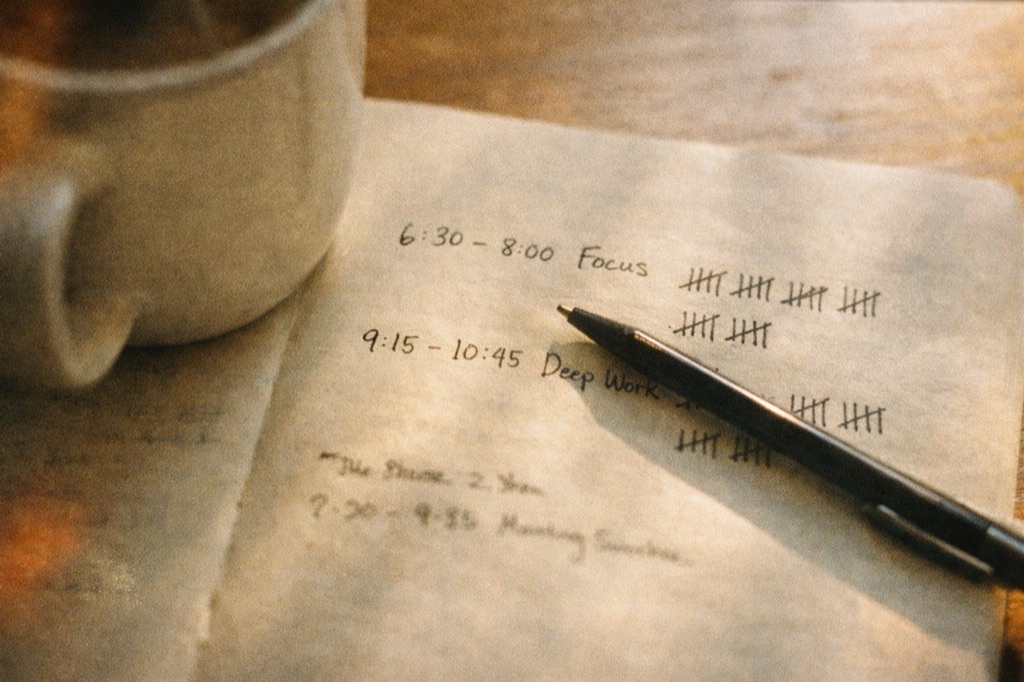
What 10,000 Hours of Focus Data Taught Me About Myself
Somewhere around the 10,000-hour mark, I stopped looking at my focus data as a productivity metric and started seeing it as a diary I never meant to write.
I’ve been tracking my focus time for years. Not casually — obsessively, at first. Every work session logged. Every break recorded. What started as a developer’s curiosity about personal optimization turned into something I didn’t expect: a brutally honest portrait of who I am when nobody’s watching.
The data didn’t just show me when I was productive. It showed me when I was lying to myself.
The First Thousand Hours Were Humbling
When I started tracking, I assumed I was a solid six-hour-a-day focused worker. That felt right. I was at my desk for eight or nine hours, and surely most of that was real work.
It wasn’t. My actual focused time in those early months averaged about three hours and forty minutes per day. On some days — days I would have described as “busy” — the number was closer to two.
That gap between perception and reality hit hard. I wasn’t slacking. I was doing things — answering messages, switching between tabs, reading articles tangentially related to work, reorganizing files. It all felt like work. The data said otherwise.
This is the first thing the numbers teach you: your sense of how you spend time is unreliable. Not slightly off. Dramatically wrong. And the more “busy” you feel, the wider the gap tends to be.
Tuesday Is My Best Day (And I Have No Idea Why)
After about eighteen months of data, I noticed something odd. Tuesdays were consistently my most focused day. Not by a small margin — I averaged forty-five minutes more deep focus on Tuesdays than on any other weekday.
I stared at this for weeks trying to find a rational explanation. Monday makes sense as a slow start. Friday as a wind-down. But why Tuesday specifically?
I never found a satisfying answer. My best theory is that Tuesday is the day with the fewest external disruptions in my particular routine — far enough from the weekend that I’m fully in work mode, but without the meeting load that tends to pile up mid-week. Or maybe it’s something entirely unconscious. A rhythm my body settled into that my mind never registered.
The point isn’t why Tuesday works. The point is that the pattern was invisible to me until the data surfaced it. I would have guessed Wednesday or Thursday. I would have been wrong.
Seasons Change Everything
This one surprised me the most. My focus capacity shifts dramatically with the seasons, and the pattern is the opposite of what I assumed.
I expected summer to be my worst season — warm weather, longer days, the pull of being outside. Instead, my summer months consistently show some of my highest focus numbers. The long daylight hours seem to extend my productive window rather than shrink it. I start earlier, I have more energy, and the brightness keeps my brain alert later into the afternoon.
Winter is a different story. December through February, my average daily focus drops by almost a full hour. The short days don’t just reduce my working hours — they reduce the quality of the hours I do work. I procrastinate more. I take longer to get started in the morning. I drift more between tasks.
Once I saw this pattern across multiple years, I stopped fighting it. I restructured my work expectations seasonally. Ambitious projects get planned for spring and summer. Winter is for maintenance, smaller tasks, and the kind of work that doesn’t require four consecutive hours of concentration. I’m not lazy in January — I’m a mammal responding to less sunlight. The data gave me permission to accept that.
The Activities That Felt Productive But Weren’t
This was the uncomfortable discovery. Certain activities that felt deeply productive — satisfying in the moment, virtuous even — turned out to be focus sinkholes.
Research rabbit holes were the biggest offender. I’d spend ninety minutes reading documentation, exploring tangential technical concepts, following link after link. It felt like learning. It felt essential. But when I looked at what I actually shipped during those sessions versus sessions where I just dove into the code, the research-heavy days produced less output almost every time.
Planning was another trap. Elaborate planning sessions where I mapped out an entire project architecture, created detailed timelines, organized tasks into perfect categories. The planning felt like progress, but the data showed that my best work periods started with minimal planning — just a single clear next step, then execution.
I’m not saying research and planning are useless. They’re necessary. But the data taught me to timebox them ruthlessly. Thirty minutes of research, then build. Fifteen minutes of planning, then start. My brain will always argue that it needs “just a bit more preparation.” The numbers proved that’s almost never true.
The Myth of the Marathon Session
Early in my tracking, I was proud of my occasional marathon focus sessions — five, six, sometimes seven hours of unbroken work. They felt heroic. I’d emerge exhausted but satisfied, convinced I’d accomplished something extraordinary.
The data told a different story. Those marathon sessions were almost always followed by one or two days of significantly below-average focus. The recovery cost erased most of the gains. When I calculated weekly output, weeks with one marathon session and two recovery days produced less total focused time than weeks with steady three-to-four-hour sessions every day.
The sweet spot turned out to be sessions of about ninety minutes, with real breaks in between — not phone breaks, not email breaks, actual stepping-away-from-the-screen breaks. Three of those per day, and I hit my most consistent numbers. It’s less dramatic than a seven-hour sprint. It’s also sustainable across months and years, which a sprint never is.
Bad Weeks Have Patterns Too
Everyone has bad weeks. But when you track enough of them, you start to see that “bad” isn’t random.
My worst focus weeks almost always share at least one of three conditions: I slept poorly for two or more consecutive nights, I had unresolved conflict or stress in my personal life, or I was working on something I didn’t believe in. The first two weren’t surprising. The third was.
There were stretches — weeks at a time — where my focus numbers cratered despite good sleep, no external stress, and plenty of free time. When I went back and matched those periods to what I was actually working on, the pattern was clear. I was building something I didn’t care about, or working on a problem I didn’t think mattered, or implementing someone else’s idea that I disagreed with.
My focus data became a kind of emotional lie detector. I could tell myself I was fine with a project, but the numbers didn’t lie. If my focus dropped for no apparent external reason, the reason was usually internal — I wasn’t aligned with the work. That’s an uncomfortable thing to learn about yourself, and an incredibly useful one.
The Data Mirror
After years of this, I’ve come to think of focus tracking less as a productivity tool and more as a mirror. Not the flattering kind. The kind that shows you exactly what’s there.
It showed me that I’m not the disciplined, consistent worker I imagined. I’m seasonal, cyclical, and deeply affected by emotional currents I don’t always notice. It showed me that my instincts about my own productivity are often wrong — sometimes spectacularly wrong. It showed me that I’m better at short focused efforts than long grinds, that Tuesdays are magic for reasons I’ll probably never understand, and that my brain will always prefer the feeling of preparation over the discomfort of execution.
None of this made me “more productive” in the way I originally hoped. I didn’t find a secret formula or unlock a hidden gear. What I found was self-knowledge — the unglamorous kind that doesn’t make for a good LinkedIn post but quietly reshapes how you approach every working day.
What I’d Tell Someone Starting to Track
If you’re thinking about tracking your focus time, here’s what I wish someone had told me.
First: the early numbers will be disappointing. Everyone overestimates their focused time. Don’t let the initial gap between expectation and reality discourage you. It doesn’t mean you’re failing — it means you’re seeing clearly for the first time.
Second: don’t optimize too early. Track for at least three months before you make any changes. You need enough data to see real patterns, not noise. A bad Tuesday doesn’t mean Tuesdays are bad. A great Monday doesn’t mean you’ve cracked the code.
Third: the most valuable insights won’t be about time management. They’ll be about self-awareness. You’ll learn what drains you and what energizes you. You’ll see emotional patterns you didn’t know you had. You’ll discover that some of your proudest work habits are actually coping mechanisms, and some of the things you feel guilty about are perfectly fine.
And finally: the point isn’t to fill every hour with focused work. I tried that. It broke me. The point is to understand your own patterns well enough to work with them instead of against them.
Frequently Asked Questions
How do you track 10,000 hours of focus time?
I used a combination of timer apps and manual logging over several years. The key was making it effortless — one tap to start a session, one tap to stop. Any system that requires more friction than that will be abandoned within a week. Focus Dog’s timer and statistics make this kind of long-term tracking genuinely simple because the gamification keeps you coming back.
What’s the ideal amount of daily focus time?
Based on my data and research on knowledge workers, three to four hours of genuine deep focus per day is excellent. Most people average less than three. If you’re consistently hitting four, you’re outperforming the vast majority. Chasing six or seven is a recipe for burnout, not better results.
Does tracking focus time create pressure to perform?
It can, especially at first. I went through a phase where I was gaming my own numbers — starting the timer during shallow work, avoiding breaks to keep the count up. That defeats the purpose. The data is only useful if it’s honest. Track what actually happens, not what you want the dashboard to show.
How long before you see meaningful patterns?
About three months for weekly rhythms, a full year for seasonal patterns. Shorter tracking periods show noise, not signal. Commit to at least ninety days before you try to draw conclusions. And even then, hold your theories loosely — some patterns I was sure about at six months turned out to be coincidence when I had two years of data.
Isn’t this just obsessive self-monitoring?
Maybe. But I’d argue there’s a difference between anxious tracking (checking the numbers constantly, feeling bad when they’re low) and reflective tracking (reviewing patterns monthly, adjusting your approach seasonally). The first makes you worse. The second made me genuinely better — not at working harder, but at understanding why I work the way I do.
Ten thousand hours is a lot of data points. But the most important number isn’t the total. It’s the pattern inside the total — the shape of your days, the rhythm of your weeks, the slow drift of your seasons. That shape is yours alone. Learning to read it is one of the most useful things I’ve ever done.
Starve distractions. Feed your focus!
Join 42.923 happy users around the world in becoming less distracted.
Download Focus Dog on the Apple App Store Download Focus Dog on the Google Play Store

How to Build a Habit That Actually Sticks (The 3-Layer Method)
Most habits fail within weeks. The 3-layer method — trigger design, friction reduction, and identity reinforcement — builds habits that last.
Read more
What Happens to Your Brain After 4 Hours of Screen Time
What 4+ hours of screen time actually does to your brain — dopamine, attention, sleep, and what you can do about it without going off the grid.
Read more
ADHD-Friendly Productivity: What Actually Works
Practical ADHD productivity tips that work with your brain, not against it — body doubling, novelty cycling, hyperfocus harnessing, and more.
Read more
How Your Time with Focus Dog helps Real Dogs in Need
Dive into Patrick's journey with Focus Dog, turning virtual wins into real help for sheltered dogs and fostering a community united by productivity and love for our furry friends.
Read moreMore from the Digital Harmony Magazine
Discover Engaging Insights on Cultivating a Balanced Connection Between Your Phone and Mind while Boosting Productivity through Gamification!
Discover the Digital Harmony Magazine