
Why Gamification Works (And Why Most Apps Get It Wrong)
I once spent three weeks maintaining a streak on a language-learning app. Not because I cared about Spanish — I’d already given up on the lessons. I was doing it because a cartoon owl would guilt-trip me if I didn’t. When I finally missed a day and the streak reset, I felt a brief flash of genuine distress. Then I deleted the app.
That’s gamification in a nutshell. When it works, it quietly reshapes your behavior around something meaningful. When it doesn’t, it manipulates you into caring about points that represent nothing.
The Word Everyone Misuses
Gamification became a corporate buzzword around 2010, and the damage was immediate. Suddenly every HR platform had badges. Every sales dashboard had leaderboards. Every onboarding flow had progress bars. Most of it was terrible.
The problem wasn’t the concept. The problem was that companies treated gamification as a coat of paint — slap some points on a boring task and people will magically care about it. That’s like putting a scoreboard in a dentist’s office and expecting patients to enjoy root canals.
Real gamification isn’t about making things feel like games. It’s about understanding why games are compelling in the first place, and applying those psychological principles to real behavior.
Variable Rewards and the Slot Machine in Your Pocket
In the 1950s, psychologist B.F. Skinner discovered something that still drives most of the apps on your phone. He put pigeons in boxes with levers. When pressing the lever delivered food on a predictable schedule, the pigeons pressed it regularly. But when the food came at random intervals — sometimes after three presses, sometimes after thirty — the pigeons pressed obsessively.
Variable reward schedules. The uncertainty itself becomes addictive.
This is why you check social media compulsively. Not because every scroll delivers something great, but because sometimes it does, and you never know when. It’s the same reason slot machines are more addictive than vending machines. The vending machine gives you exactly what you expect. The slot machine gives you possibility.
Good gamification uses variable rewards ethically — to reinforce behaviors you actually want. A fitness app that occasionally surprises you with a bonus achievement after a workout is using this well. A social media app that withholds notifications and then dumps them all at once to pull you back is using the same psychology exploitatively.
The line between motivation and manipulation lives here. And most apps are standing on the wrong side.
Progress Mechanics: Why Leveling Up Feels So Good
There’s a reason every RPG has a level-up system. Watching a progress bar fill activates the same neural circuits as approaching a physical goal — your brain releases dopamine not at the moment of completion, but during the approach. The anticipation is the reward.
This is called the goal gradient effect, and it’s been studied since the 1930s. Rats run faster as they get closer to food at the end of a maze. Coffee loyalty cards get stamped faster toward the free drink. And you work harder on a project when you can see the finish line.
Progress mechanics work in apps when they track something real. A writing app that shows you climbing toward your daily word count is genuinely useful. A corporate training platform that gives you a level-5 badge for watching five compliance videos is not. The difference is whether the progress represents actual growth or just consumption.
The best progress systems do something subtle: they make your effort visible to yourself. Most of our daily work is invisible. You can’t see the emails you processed, the focus you maintained, the small decisions you made well. Habit tracking makes that invisible work concrete — and that visibility itself becomes motivating.
The Streak Trap
Streaks are gamification’s most popular and most dangerous tool. Duolingo, Snapchat, GitHub, meditation apps — everyone loves a streak counter. And for good reason: streaks exploit loss aversion, which is roughly twice as powerful as the desire for gains. Losing a 50-day streak feels terrible, so you’ll go to absurd lengths to maintain it.
Here’s where it gets toxic. When the streak becomes the goal, the original behavior becomes meaningless. You do your Duolingo lesson at 11:57 PM, half-asleep, tapping randomly just to keep the number alive. You snap a black screen to your friend at midnight because the streak must survive. The behavior continues, but the purpose is gone.
Good streak design has two features that most apps miss. First, it allows for recovery — a grace period, a freeze, a way to miss a day without losing everything. Because life happens, and punishing someone for being human doesn’t build habits; it builds resentment. Second, it ties the streak to outcomes, not just participation. “30 days of focused work sessions” means more than “30 days of opening the app.”
Social Proof and the Leaderboard Problem
Humans are social animals. We calibrate our behavior based on what others around us do. This is social proof — one of the most powerful forces in human psychology, and one of the most commonly botched in gamification.
Leaderboards seem like an obvious win: show people where they rank, and they’ll try harder. Sometimes that works. But research by Werbach and Hunter found that leaderboards often demotivate the majority. If you’re in the top ten, a leaderboard pushes you to compete. If you’re in the bottom fifty, it confirms that you’re behind — and many people respond by giving up entirely.
The fix? Small, relative leaderboards. Competing with your close friends rather than the entire world. Seeing that your colleague also focused for three hours today, rather than seeing that some stranger in Tokyo focused for twelve. Social comparison works when it feels achievable and personal, not when it feels like shouting into a stadium.
This is partly why the original connection between real life and digital engagement matters so much. Gamification that connects you to real people in your life hits differently than gamification that connects you to strangers on a scoreboard.
Intrinsic vs. Extrinsic: The Motivation Seesaw
Here’s the uncomfortable truth that most gamification designers ignore: external rewards can actually destroy internal motivation.
Psychologist Edward Deci demonstrated this in the 1970s. He had two groups solve puzzles. One group got paid per puzzle. The other got nothing. When the experiment ended, the unpaid group kept solving puzzles for fun. The paid group stopped immediately. Paying them had turned play into work.
This is called the overjustification effect, and it haunts bad gamification. If someone enjoys running, giving them badges for every mile might initially boost their activity. But over time, they start running for badges instead of for the joy of running. Remove the badges and the running stops — even though they were running happily before the badges existed.
Good gamification avoids this trap by supporting intrinsic motivation rather than replacing it. Self-determination theory identifies three needs: autonomy (I chose this), competence (I’m getting better), and relatedness (I’m connected to others). Gamification that feeds these three needs enhances existing motivation. Gamification that ignores them and just dangles rewards creates dependence on the reward system.
The question isn’t “what rewards should we give?” It’s “what does the person already want to do, and how do we make that easier and more visible?”
What Good Gamification Actually Looks Like
Strip away the buzzwords and bad implementations, and effective gamification comes down to a few principles.
It makes invisible progress visible. You can see your effort accumulating, which makes continued effort feel worthwhile.
It creates natural checkpoints. Short sessions with clear beginnings and endings are more sustainable than open-ended commitments. This is why the Pomodoro technique works, why games have levels, and why a 25-minute focus session feels more doable than “focus until you’re done.”
It connects to something you care about. Points for their own sake are hollow. Points that represent time spent on your thesis, or workouts completed, or focus sessions that helped you finish a project — those mean something.
It respects your autonomy. You chose to engage. You can disengage without punishment. The system supports your goals; it doesn’t hijack them.
Focus Dog applies these principles in a way that still surprises me. The donut-earning mechanic works not because collecting virtual donuts is inherently exciting, but because it makes focused time tangible. Every session produces something visible. Your dog depends on you — not in a guilt-trip way, but in a way that gives your focus a playful purpose beyond the work itself. The social leaderboard with friends keeps it personal, not competitive-at-scale. And crucially, it ties rewards to actual focused time — you can’t game it by just opening the app.
Why Most Apps Still Get It Wrong
The majority of gamified apps fail because they start with the game mechanics and work backward. They ask “what badges and points should we add?” instead of “what behavior are we trying to support, and what’s actually preventing it?”
Badge fatigue is real. When everything earns a badge, nothing does. Corporate platforms hand out achievements for logging in, completing profiles, reading announcements — and employees learn to ignore all of them. The dopamine hit of a reward depends on it feeling earned. An achievement for breathing isn’t an achievement.
The worst offenders use gamification as a retention trick rather than a motivation tool. They don’t care whether you’re getting value. They care whether you’re opening the app. Dark patterns disguised as game design — artificial urgency, punitive streak resets, social pressure notifications — aren’t gamification. They’re manipulation wearing a fun hat.
Frequently Asked Questions
Is gamification just manipulation by another name?
It can be. The difference is intent and transparency. Manipulation hides its mechanisms and serves the app’s goals over the user’s. Ethical gamification is transparent about its mechanics and primarily serves the user’s goals. If removing all the game elements would reveal that the app provides no actual value, that’s manipulation. If the game elements enhance something already valuable, that’s good design.
Why do streaks work so well even when we know they’re arbitrary?
Loss aversion is hardwired. Knowing that a streak is “just a number” doesn’t make losing it feel less real — the same way knowing a movie is fiction doesn’t stop you from crying. Streaks work because they transform an abstract goal (“be consistent”) into a concrete, visible one (“keep the number going”). The trick is finding streaks attached to real progress, not just app opens.
Can gamification help with serious goals like fitness or studying?
Absolutely, and the research backs it up. A 2019 meta-analysis in Computers in Education Review found that gamification improved learning outcomes in 67% of studied cases. The key is that the gamification supports the underlying activity rather than replacing it. A study app that rewards you for answering questions correctly supports learning. One that rewards you for time-in-app regardless of engagement does not.
What’s the difference between gamification and just making something fun?
Gamification specifically borrows mechanics from game design — progress tracking, rewards, challenges, social elements. Making something fun is broader and often better. The best products do both: the core experience is enjoyable, and game mechanics amplify that enjoyment. The worst products use gamification as a substitute for being fun — and that never works for long.
How do I know if an app’s gamification is helping me or hooking me?
Ask yourself two questions. First: am I making progress toward my actual goal, or just collecting in-app rewards? Second: if I stopped using the app tomorrow, would I have built any real skills or habits? If the answer to the first question is yes and the second is also yes, the gamification is working for you. If you’re just feeding a streak that disappears the moment you stop, you’re the product, not the player.
The gap between good gamification and bad gamification isn’t about polish or budget. It’s about whether the designers asked “how do we help this person succeed?” or “how do we keep this person coming back?” One question builds tools. The other builds traps. Every app with a points system is making that choice — and so is every person deciding which apps deserve their time.
Starve distractions. Feed your focus!
Join 42.923 happy users around the world in becoming less distracted.
Download Focus Dog on the Apple App Store Download Focus Dog on the Google Play Store

Psychology of Time: How Time Tracking Apps Can Enhance Your Self-awareness
Explore the intricate psychology of time management and discover how time tracking apps like Focus Dog can enhance self-awareness for improved productivity and personal growth.
Read more
Time Blocking for People Who Hate Rigid Schedules
Time blocking doesn't have to feel like a prison. Learn a flexible approach that works for creative thinkers and non-linear planners.
Read more
The Productivity Myth: Why Doing Less Gets You More Done
The best productivity tips aren't about doing more. Learn why strategic rest, shorter work sessions, and doing less can dramatically increase your output.
Read more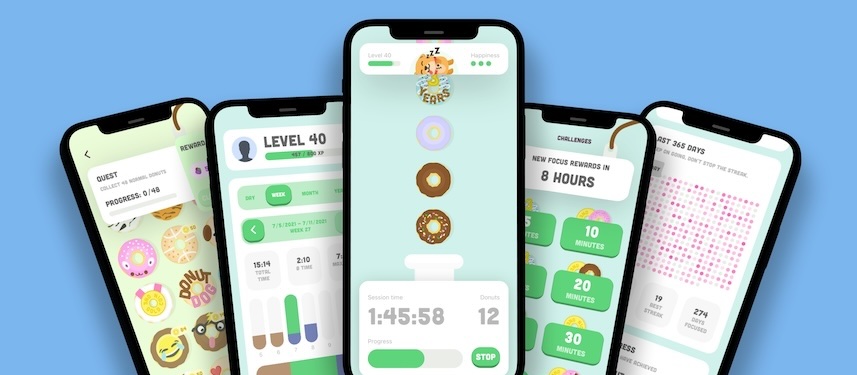
The Power of Habit-Tracking: How Focus Dog App Can Build Positive Routines
Learn how Focus Dog empowers users to establish and maintain positive habits for personal and professional growth in an engaging and rewarding manner.
Read moreMore from the Digital Harmony Magazine
Discover Engaging Insights on Cultivating a Balanced Connection Between Your Phone and Mind while Boosting Productivity through Gamification!
Discover the Digital Harmony Magazine