
Meeting Fatigue Is Real — Here's How to Recover Your Focus After Back-to-Back Calls
Three meetings before lunch. A “quick sync” at 1 PM that runs forty minutes. A project check-in at 2:30. By 3 PM, you’re staring at your actual work with the cognitive capacity of a damp sponge. You know what you need to do. You just can’t make your brain do it.
Meeting fatigue isn’t laziness. It’s a measurable neurological response to a very specific kind of cognitive load — and most people have no strategy for dealing with it beyond “push through.” That doesn’t work. Here’s what does.
Why Video Calls Drain You More Than In-Person Meetings
A 2021 Stanford study coined the term “Zoom fatigue” and identified four specific causes: excessive close-up eye contact, constantly seeing your own face, reduced physical mobility, and the heightened cognitive effort of interpreting nonverbal cues through a screen.
In a real room, eye contact is shared and intermittent. On video, everyone appears to be staring directly at you, all the time. Your brain reads this as a threat-level amount of eye contact, which triggers low-grade stress responses continuously throughout the call.
Then there’s “the Zoom face” — the conscious effort to look engaged on camera. You nod more deliberately, manage your facial expressions, and monitor your own video feed. None of this happens naturally in a conference room. It’s performative labor on top of the actual meeting content, and it’s exhausting in a way that’s hard to articulate but impossible to ignore.
Camera-on meetings cost more cognitive energy than camera-off. A study from the University of Arizona found that participants with cameras on reported significantly higher fatigue levels. Not because they were doing more — because their brains were working harder to maintain social performance while simultaneously processing information.
The Cognitive Cost Nobody Accounts For
Here’s what most people miss: the problem isn’t just the meetings themselves. It’s the transition damage.
Every meeting forces a context switch. Your brain was working on a project, then it shifted to a budget discussion, then to a team standup, then to a client call. Each switch carries what researchers call “attention residue” — fragments of the previous topic lingering in working memory while you try to engage with the current one.
After two meetings, the residue is manageable. After four or five, your working memory is so cluttered with half-processed information from different contexts that genuinely focusing on anything becomes nearly impossible. You’re not tired in a physical sense. Your cognitive workspace is full.
This explains the 3 PM wall. It’s not the meetings themselves that destroyed your afternoon — it’s the accumulated context-switching cost that left your brain with no clean mental space to think. Most people respond by checking email or scrolling their phone, which adds even more context switches. The hole gets deeper.
The Five-Minute Sensory Reset
The fastest way to recover between meetings is a sensory reset — deliberately changing your physical inputs to signal to your brain that the previous context is over.
Stand up. That’s step one, and it matters more than you think. Sitting in the same chair, in the same position, staring at the same screen tells your brain you’re still in the same context. Physical movement breaks that loop.
Next, change your visual input. Look out a window. Walk to another room. Even closing your laptop lid for sixty seconds forces a visual context switch. Your brain needs a signal that says “that’s done, something new is starting.”
Cold water on your wrists or face triggers a mild parasympathetic response — your nervous system’s way of downshifting from alert mode to recovery mode. It sounds basic because it is basic. Your nervous system doesn’t need complex interventions. It needs clear signals.
Thirty seconds of intentional breathing — slow inhale, longer exhale — drops your heart rate and cortisol levels measurably. Not ten minutes of meditation. Thirty seconds.
Put these together and you have a five-minute routine that genuinely resets your cognitive state: stand, move, change your visual field, cold water, breathe. It won’t erase four hours of meetings, but it’ll give you a clean enough mental workspace to actually do something productive afterward.
Micro-Movement Between Calls
Your body isn’t designed to sit still for hours while your brain sprints. When you do, the physical stagnation amplifies mental fatigue. Blood pools in your lower body, oxygen delivery to your brain decreases, and your alertness drops.
Between meetings, move. Not exercise — just movement:
- Walk to the kitchen and back. Get water whether you need it or not.
- Ten jumping jacks. Stupid simple. Immediately increases blood flow to the brain.
- Stretch your hip flexors, which tighten from sitting and contribute to the sluggish feeling.
- Stand for the next meeting instead of sitting, if it’s a shorter call.
Research on “exercise snacks” — brief bursts of movement lasting one to three minutes — shows they’re surprisingly effective at restoring alertness and reducing fatigue. You don’t need a workout. You need your body to remember it’s not a chair attachment.
The Focus Sprint Recovery Method
After your last meeting of a block, your brain needs a bridge back to deep work. Jumping straight into a complex task usually fails because your cognitive workspace is still fragmented from all the context switches.
The fix is a focus sprint: a short, low-stakes work session that eases your brain back into single-task mode.
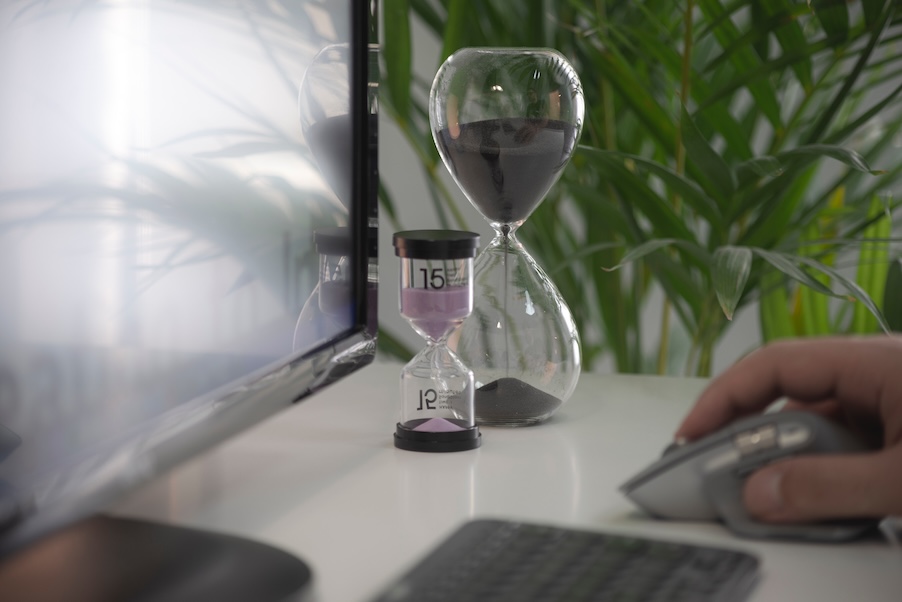
Set a timer for ten to fifteen minutes. Pick one small, concrete task — reply to a specific email, outline one section of a document, review a single pull request. The task needs to be simple enough that you can engage without full cognitive capacity, but real enough that your brain recognizes it as work rather than filler.
This works because it clears the attention residue. By focusing on one thing — even something easy — you give your brain time to flush the fragments from previous meetings. After the sprint, your working memory is cleaner, and stepping into deeper work feels possible instead of overwhelming.
Apps like Focus Dog can make this transition easier — starting a short timer turns the recovery sprint into a contained, gamified moment rather than an open-ended “I should probably get back to work” guilt spiral. The timer creates boundaries, and the boundaries create focus.
Protecting Your Calendar Before It Protects You
Recovery techniques matter, but the most effective strategy is reducing the damage in the first place. Meeting culture is a design problem, not an inevitability.
Block transition time. Schedule meetings for 25 or 50 minutes instead of 30 or 60. Those five to ten minutes between calls aren’t wasted time — they’re the recovery windows your brain needs. If your calendar tool doesn’t enforce this, do it manually by declining or rescheduling meetings that stack without gaps.
Batch your meetings. Scattering meetings throughout the day guarantees maximum context-switching damage. Push meetings into a single block — morning or afternoon — and protect the other half for focused work. A bad morning of back-to-back calls followed by a clean afternoon is dramatically more productive than meetings sprinkled every ninety minutes all day.
Go camera-off when possible. If the meeting doesn’t require face-to-face interaction — status updates, information sharing, large all-hands — turn your camera off. You’ll reduce the cognitive load significantly. Not every workplace culture allows this, but where it’s an option, use it without guilt.
Audit ruthlessly. Ask yourself about every recurring meeting: “Would I notice if this meeting disappeared?” If the answer is no, decline it or propose replacing it with an async update. Many people attend eight to ten meetings per week that generate zero value for them. That’s an entire workday of unnecessary cognitive stress every week.
What to Do When You’re Already Fried
Sometimes you can’t prevent it. You had six meetings, zero breaks, and now you’re supposed to deliver real work. Your brain feels like static.
First, accept it. Trying to force deep work when you’re cognitively depleted is like trying to sprint after running a marathon. You’ll produce low-quality work slowly, which is worse than producing nothing.
Instead, switch to low-executive-function tasks for thirty to sixty minutes. Organize files. Clear your inbox — not thoughtful replies, just sorting and flagging. Review your task list. Do the kind of work that keeps things moving without requiring creative thought.
If even that feels impossible, take a real break. Walk outside for fifteen minutes. Not a phone-scrolling break — an actual sensory-change break. The research on attention restoration theory shows that natural environments are particularly effective at replenishing depleted cognitive resources. A fifteen-minute walk in a park does more for your focus than an hour of “resting” at your desk.
Your brain will come back. It always does. The question is whether you waste the depleted time fighting it or use that time wisely and then show up sharp when your capacity returns.
Building a Sustainable Meeting Day
The goal isn’t eliminating meetings — some meetings genuinely matter. The goal is designing your meeting day so that you can still think afterward.
A sustainable meeting day looks something like this: meetings clustered in one half of the day, five-minute movement breaks between each call, a fifteen-minute transition ritual before starting focused work, and an honest assessment of which meetings need you present versus which ones need a summary email.
Track your focus and mental energy patterns for a week. When do your meetings drain you most? When do you recover fastest? When is your brain sharpest for deep work? Use the data to redesign your calendar around what you actually observe rather than what your company’s default scheduling assumes.
Meeting fatigue is real, but it’s not random. It has specific causes and specific solutions. The techniques in this article — sensory resets, micro-movement, focus sprints, calendar protection — aren’t complicated. They just require treating your cognitive capacity as a finite resource that deserves the same protection as your time.
Frequently Asked Questions
How long does it take to recover focus after back-to-back meetings?
Research suggests fifteen to twenty-three minutes to fully regain deep focus after a context switch. After multiple meetings, expect thirty to sixty minutes of reduced capacity. Using the sensory reset and focus sprint techniques described above can cut this recovery time significantly, but the most effective approach is preventing the stack in the first place.
Is meeting fatigue worse for remote workers?
Yes, generally. Remote workers tend to have more video calls than in-office workers have face-to-face meetings, and video calls carry higher cognitive costs. The “always-on camera” expectation, the lack of natural transitions (walking between rooms), and the absence of informal social cues all contribute to greater depletion.
Should I turn my camera off during meetings?
When the meeting format allows it — large calls, status updates, presentations where you’re an audience member — yes. Camera-off reduces the performative cognitive load substantially. For smaller collaborative meetings where visual engagement matters, keep it on but take the other recovery steps seriously between calls.
Can meeting fatigue contribute to burnout?
Absolutely. Chronic meeting overload is one of the most common contributors to workplace burnout because it creates a daily cycle of cognitive depletion followed by pressure to still complete focused work. Over time, this pattern erodes both your capacity and your motivation. Protecting your calendar isn’t a luxury — it’s preventative maintenance.
What’s the ideal number of meetings per day?
There’s no universal answer, but research on cognitive load suggests that three to four hours of meetings is the practical upper limit for most people before deep work becomes significantly impaired. If you’re exceeding that regularly, something in the system needs to change — not your willpower.
You didn’t lose your afternoon to laziness. You lost it to a calendar that treated your attention like an infinite resource. It isn’t. Protect it, recover it when it’s depleted, and stop accepting that the 3 PM fog is just how work feels. It doesn’t have to be.
Starve distractions. Feed your focus!
Join 42.923 happy users around the world in becoming less distracted.
Download Focus Dog on the Apple App Store Download Focus Dog on the Google Play Store
Psychology of Time: How Time Tracking Apps Can Enhance Your Self-awareness
Explore the intricate psychology of time management and discover how time tracking apps like Focus Dog can enhance self-awareness for improved productivity and personal growth.
Read more
The Balance Between Phone Usage and Mental Wellness
My strategies for maintaining a harmonious relationship with my phone to enhance my mental well-being.
Read more
Why Your Study Playlist Might Be Ruining Your Focus
Does music help or hurt your studying? The science of how your study playlist affects focus, memory, and concentration — and what to listen to instead.
Read more
How to Actually Focus When Your Brain Won't Cooperate
Struggling to focus? Learn science-backed techniques to regain concentration when your brain feels scattered and distracted.
Read moreMore from the Digital Harmony Magazine
Discover Engaging Insights on Cultivating a Balanced Connection Between Your Phone and Mind while Boosting Productivity through Gamification!
Discover the Digital Harmony Magazine