
Deep Work Is Overrated (Unless You Do It Like This)
I read Cal Newport’s Deep Work a few years ago and immediately tried to restructure my entire life around it. Four-hour focus blocks. No social media. A monk-like devotion to undistracted concentration. It lasted about three days before I burned out and spent an entire afternoon watching cooking videos.
The book is brilliant. The problem is how people — myself included — try to implement it.
The Deep Work Fantasy vs. Reality
The popular image of deep work looks something like this: you wake up early, sit down at a clean desk, enter a flow state, and produce genius-level output for four uninterrupted hours. Then you emerge, satisfied and accomplished, ready for a leisurely lunch.
I don’t know anyone who actually works like this. Not consistently. Maybe a handful of tenured professors and novelists with no kids and a cabin in the woods, but not normal people with Slack notifications and dentist appointments and that weird noise the dishwasher started making last week.
The gap between the deep work ideal and everyday reality causes a lot of unnecessary guilt. People try the four-hour marathon, fail, conclude they lack discipline, and give up entirely. But the approach was wrong, not the person.
Why 90 Minutes Beats 4 Hours
There’s solid research behind shorter deep work sessions. Anders Ericsson — the psychologist whose work on deliberate practice inspired much of the deep work movement — studied elite performers across dozens of fields. Violinists, chess grandmasters, athletes. His finding? They rarely practiced in sessions longer than 90 minutes. And they rarely accumulated more than four hours of intense practice in a single day.
These are people at the absolute top of their craft. If world-class violinists can’t sustain deep focus beyond 90 minutes at a stretch, why do we expect office workers replying to Jira tickets to do it for four?
The 90-minute mark isn’t arbitrary. It aligns with our ultradian rhythms — the natural cycles of alertness and fatigue that your body runs on throughout the day. After about 90 minutes of concentrated effort, your brain genuinely needs a break. Push through and you get diminishing returns: more time at the desk, less actual output.
The Gradual Buildup Nobody Talks About
Here’s what most deep work advice skips entirely: you have to build up to it. You can’t go from checking your phone every three minutes to 90-minute focus blocks overnight. That’s like someone who hasn’t run in years trying to complete a half marathon.
Start embarrassingly small. Twenty minutes. Set a timer and focus on one single task for twenty minutes. No phone. No email. No “quick check.” Just the work.
When twenty minutes feels easy — and it will take longer than you think — bump it to thirty. Then forty-five. Then sixty. Only after you can consistently hit sixty comfortable minutes should you attempt ninety.
The Pomodoro method is an excellent on-ramp for this. Twenty-five minutes of focus, five minutes of rest. It’s not deep work in the traditional sense, but it trains the same muscle. Once Pomodoro sessions feel too short, you’ve outgrown them — and that’s a good sign.
The Environment Matters More Than Willpower
Cal Newport is right about one thing: environment design is everything. But you don’t need a wood-paneled study or a library carrel. You need three things.
A consistent trigger. Same place, same time, same opening ritual. My trigger is putting on noise-cancelling headphones. The moment they go on, my brain knows what’s coming. For you it might be making a specific tea, closing your door, or opening a particular app.
Reduced decision points. Before you start, decide what you’ll work on. Just one thing. Not “I’ll work on the project” but “I’ll draft the introduction to section three.” When the session starts, you shouldn’t be deciding what to do. You should already be doing it.
Physical separation from your phone. Not airplane mode. Not face-down on the desk. In another room. The mere presence of your phone — even when it’s off — reduces cognitive capacity. A study from the University of Texas at Austin showed that people performed worse on cognitive tasks when their phone was visible, even if they weren’t using it. Managing those outside influences is half the battle.
What Counts as Deep Work (and What Doesn’t)
People get confused about what qualifies. Deep work isn’t just “working hard.” It’s cognitively demanding work that requires sustained concentration and produces meaningful output. Writing, coding, designing, analyzing data, solving complex problems, learning a difficult skill.
What it isn’t: email. Meetings. Administrative tasks. Organizing your to-do list. Scrolling through research without taking notes. These are shallow work — necessary, but not the stuff that moves the needle.
The distinction matters because many people block off “deep work time” and then fill it with tasks that don’t require deep focus. Two hours of strategic thinking is deep work. Two hours of answering emails with your door closed is just… working with your door closed.
Be honest about how you spend your focus blocks. Track it for a week if you aren’t sure. You might find that your “deep work” sessions contain a lot more shallow work than you realize.
The Recovery Is Part of the Process
Rest isn’t the opposite of deep work. It’s the other half of it.
When you finish a deep work session, your brain doesn’t just stop processing. It shifts into what neuroscientists call the default mode network — a background processing state where your brain consolidates information, makes connections, and generates insights. This is why solutions to hard problems often appear while you’re showering or walking the dog.
Skipping recovery means skipping this processing. That’s why back-to-back deep work sessions have such harsh diminishing returns. Your brain needs the downtime to actually integrate what you produced during the focused period.
Take real breaks between sessions. Walk outside. Stare out a window. Do something physical. Scrolling your phone doesn’t count — it’s more input when your brain needs less.
A Realistic Deep Work Day
Forget the four-hour fantasy. Here’s what an honest deep work day looks like for most people:
Morning session — 60 to 90 minutes. This is your prime time. Protect it. Do the hardest, most cognitively demanding work here. No email before this block. No meetings. Nothing.
Recovery — 20 to 30 minutes. Walk, stretch, get coffee. Not at your desk.
Second session — 45 to 60 minutes. Slightly lighter cognitive load. Continue the morning’s project or tackle a second focused task.
The rest of the day — shallow work, admin, meetings, communication. This is when you do the stuff that keeps the lights on but doesn’t require your best thinking.
That’s two to two-and-a-half hours of real deep work. Which might sound like nothing until you realize it’s more genuine focused output than most people produce in a week of unfocused eight-hour days.
Tracking Deep Work Without Obsessing Over It
Knowing how much deep work you actually do — versus how much you think you do — is valuable. But don’t turn it into a competitive metric you stress over. The point is awareness, not optimization theater.
A simple approach: at the end of each deep work session, jot down how long it lasted and what you produced. That’s it. Over a few weeks, patterns emerge. You’ll see which days and times work best, which tasks genuinely need deep focus, and how much you can sustainably handle.
Focus Dog is useful here because it naturally tracks your focus time without adding friction. You start the timer when you begin a session, stop when you’re done, and over time your stats show you exactly how your deep work practice is developing. Plus, there’s a strange satisfaction in watching your donut count grow alongside your actual productivity.
Frequently Asked Questions
How many hours of deep work per day is realistic?
For most people, two to three hours of genuine deep work is a strong day. Elite performers across fields rarely exceed four hours. Start with one focused session and build from there rather than aiming for a number that sounds impressive but isn’t sustainable.
Can I do deep work in a noisy environment?
It’s harder, but possible. Noise-cancelling headphones with white noise or brown noise can create a usable bubble. The bigger factor is interruption frequency — ambient noise is manageable, but someone tapping your shoulder every ten minutes isn’t. If noise is unavoidable, shorten your sessions and take more frequent breaks.
Is deep work the same as flow state?
Not exactly. Flow is a psychological state where you lose track of time and effort feels effortless. Deep work is a practice — an intentional commitment to focused, undistracted work. Flow sometimes happens during deep work, but deep work doesn’t require flow. You can do excellent deep work while fully aware that it’s difficult.
What if my job doesn’t allow for long uninterrupted blocks?
Work with what you have. Even three focused 25-minute Pomodoro sessions with no interruptions will outperform a full day of fragmented attention. Talk to your manager about protecting one or two morning hours a few times per week. Frame it as output improvement, not personal preference.
How do I know if I’m doing deep work or just sitting at my desk?
Ask two questions: Am I doing something cognitively demanding? And am I giving it my full attention? If the answer to both is yes, it’s deep work. If you’re multitasking, checking notifications, or doing something that doesn’t challenge you mentally, it’s not — no matter how long you sit there.
Deep work isn’t about becoming a hermit or achieving some superhuman state of concentration. It’s about being honest with yourself about how focus actually works — in short bursts, with real breaks, and without the pressure to perform like a machine. Ninety minutes of genuine focus will always beat four hours of pretending. Start short, build gradually, protect the sessions you have, and let the results speak for themselves. And when you need something to hold you accountable during those sessions, Focus Dog makes it a little easier to stay in the zone — one donut at a time.
Starve distractions. Feed your focus!
Join 42.923 happy users around the world in becoming less distracted.
Download Focus Dog on the Apple App Store Download Focus Dog on the Google Play Store

Minimizing Stress through Consciously Lowering Outside Influences
Learn how to navigate through the tumultuous waters of stress, information overload, social comparison, work pressure, and environmental stressors.
Read more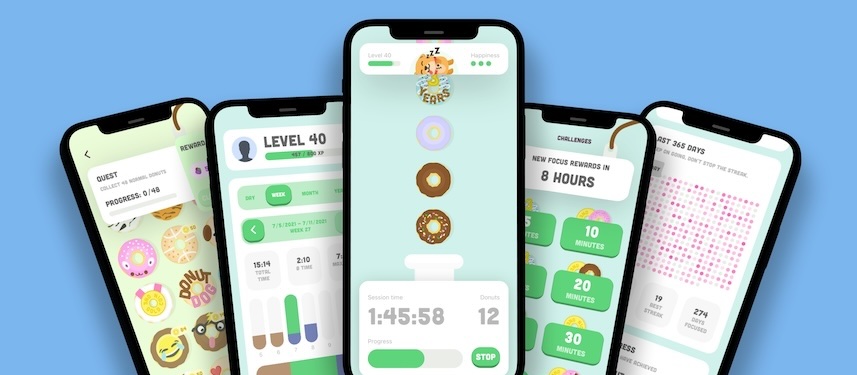
The Power of Habit-Tracking: How Focus Dog App Can Build Positive Routines
Learn how Focus Dog empowers users to establish and maintain positive habits for personal and professional growth in an engaging and rewarding manner.
Read more
Time Blocking for People Who Hate Rigid Schedules
Time blocking doesn't have to feel like a prison. Learn a flexible approach that works for creative thinkers and non-linear planners.
Read more
How to Stop Picking Up Your Phone Every 5 Minutes
Why you keep reaching for your phone and practical friction techniques to break the habit loop — without willpower or going cold turkey.
Read moreMore from the Digital Harmony Magazine
Discover Engaging Insights on Cultivating a Balanced Connection Between Your Phone and Mind while Boosting Productivity through Gamification!
Discover the Digital Harmony Magazine